



An AI agent is an AI system that can pursue a goal by deciding what steps to take, using tools, observing the results and adjusting what it does next. That is the important distinction. A normal chatbot produces an answer. An agent is designed to do work.
OpenAI defines agents as systems that independently accomplish tasks on a user's behalf. Its current guidance says an agent uses a model to manage workflow execution and has access to tools that let it gather information or take actions. Anthropic uses a similar distinction: workflows follow predefined paths, while agents dynamically direct their own process and tool use. (Sources: OpenAI, 'A practical guide to building agents'; Anthropic, 'Building Effective Agents')
The word autonomous can make agents sound more magical than they are. A production agent is still software with explicit permissions, tools, instructions, stopping conditions and monitoring. The model may choose the next step, but the surrounding system decides what it is allowed to do.
QUICK ANSWER
An AI agent is an LLM-powered software system that receives a goal, reasons about what to do, uses tools to interact with the outside world, observes tool results, and repeats the loop until it finishes or reaches a stopping condition. Its basic building blocks are a model, instructions, tools and state or context.
The easiest mental model is: chatbot = answer, automation = fixed recipe, agent = goal plus a model-controlled plan. Agents are useful when the task is open-ended enough that the exact steps cannot be known in advance. They are a bad fit when a normal deterministic workflow can solve the problem more cheaply and reliably.
1. AI Agent Definition in Plain English
Imagine asking a human assistant: 'Find the three best laptops under ₹80,000, compare them, check current prices, and recommend one for video editing.' A simple chatbot can tell you what to look for. An agent could search stores, collect specifications, compare the options, calculate tradeoffs, and produce a recommendation.
The difference is action. The agent does not only generate text. It can decide to search, call an API, read a file, run code, inspect a webpage, query a database or hand work to another agent.
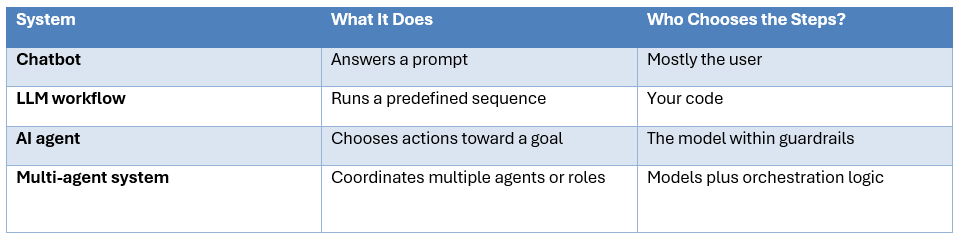
2. AI Agent vs Chatbot
This is the most common source of confusion. A chatbot can use an LLM, maintain conversation history and even call a few backend functions without becoming a fully agentic system. The key question is whether the model controls the execution path.
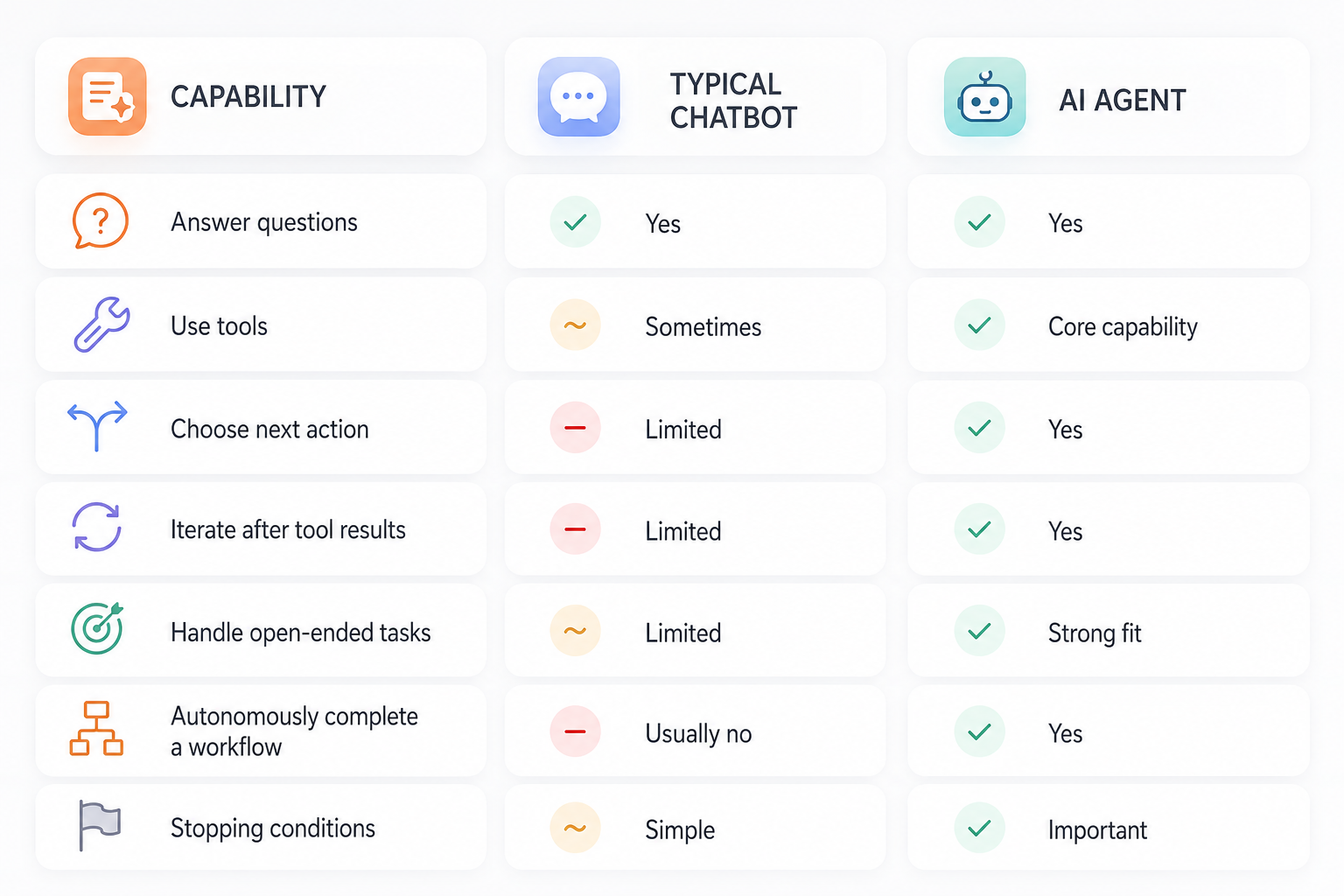
OpenAI explicitly excludes simple chatbots, single-turn LLM calls and classifiers from its definition of agents when the LLM is not controlling workflow execution. Anthropic similarly distinguishes workflows with predefined code paths from agents that dynamically direct their own process. Those definitions are useful because they stop the word 'agent' from being applied to every application that happens to call an LLM.
3. AI Agent vs Automation
Automation and agents overlap, but they solve different problems. An automation says: when event X happens, execute steps A, B and C. An agent says: achieve goal Y using the available tools, and decide which steps are necessary.
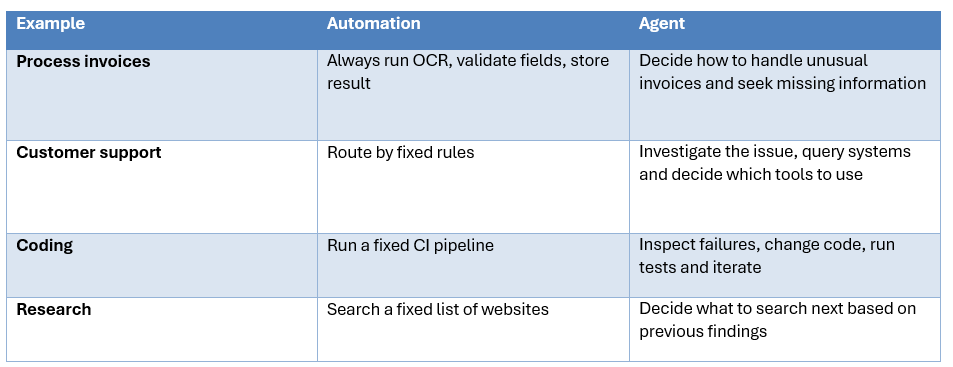
The downside of the agent approach is real: more flexibility means less predictability, more latency, more tokens and more possible failure modes. Anthropic recommends starting with the simplest solution and increasing complexity only when the task actually benefits from it.
4. How Does an AI Agent Work?
A practical AI agent loop looks like this:
- Receive a goal or task.
- Interpret the task and current context.
- Choose the next action or tool.
- Execute the tool.
- Observe the result.
- Update its working state.
- Decide whether the goal is complete.
- Repeat or stop.
This loop is more important than any particular framework. OpenAI's current agent guidance describes the model as managing workflow execution, using tools, recognizing completion, correcting actions and halting or handing control back when needed. Anthropic describes the same broad pattern as planning, acting, observing and repeating.
5. The Four Core Components of an AI Agent
The exact architecture varies, but almost every practical agent can be explained using four layers.
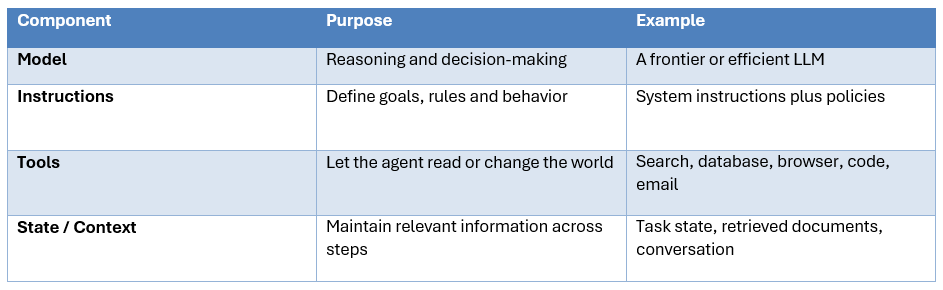
OpenAI's agent guide describes model, tools and instructions as the fundamental components. State and context become essential once the agent works across multiple turns, tools or stages. Modern agent frameworks expose additional features such as handoffs, guardrails, memory, tracing and persistence.
6. What Are AI Agent Tools?
Tools are the action layer. Without them, an agent is mostly a reasoning system trapped inside a text box.
OpenAI's current Agents SDK documentation groups tools into capabilities such as hosted tools, function tools, built-in execution tools, agents as tools and MCP servers. Tools can fetch data, call APIs, execute code or interact with a computer. Anthropic similarly emphasizes that agent performance depends heavily on the quality and design of the tools the model can use.
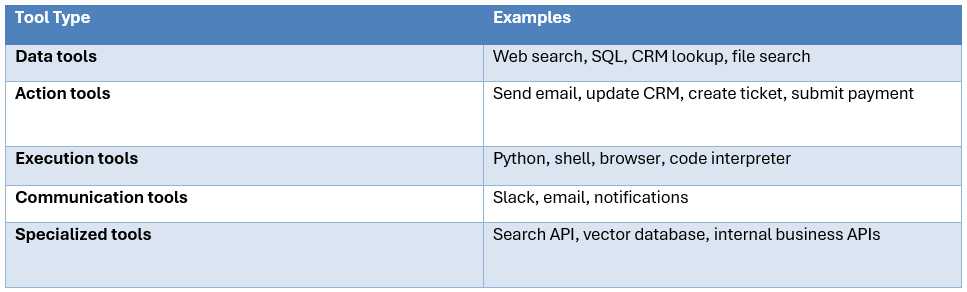
The tool definition should be narrow. Giving an agent one giant function called do_anything() is a bad design because it hides permissions and makes tool choice harder. Good tools expose one useful capability with clear inputs, outputs and failure behavior.
For deeper guidance on tool design and agent boundaries, see our How to Secure AI Coding Agents in 2026.
7. Do AI Agents Have Memory?
They can, but memory is often misunderstood. An agent does not need a giant permanent memory store to be useful. Many systems only need working state for the current task.
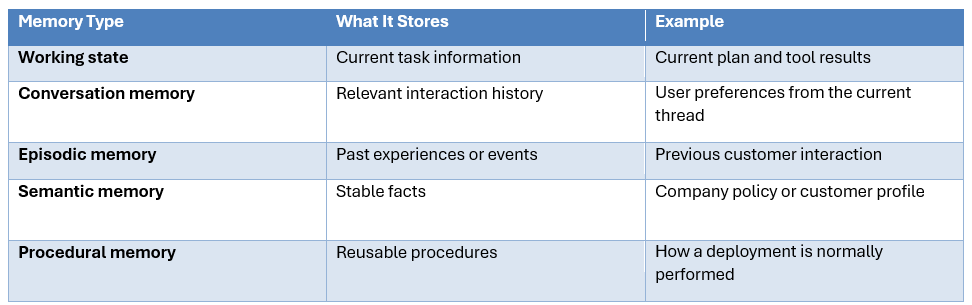
The right question is not 'How much memory can I give the agent?' It is 'What information does the agent need at this step?' Dumping every past interaction into every prompt wastes context and can make decisions worse.
Our What Is Context Engineering? Complete Guide (2026) explains why selecting useful context matters more than simply increasing the context window.
8. What Is Agent Planning?
Planning is how an agent turns a high-level goal into actions. Some agents create an explicit plan first. Others use a lighter loop where they decide only the next action. There is no universal requirement that an agent must produce a visible checklist.
For simple tasks, planning can be overkill. For complex tasks, an explicit plan can help with dependencies, parallel work and progress tracking. The better design depends on how uncertain the task is and how costly an incorrect action would be.
One useful pattern is plan, act, observe, revise. The agent proposes a route, executes a safe step, inspects the result and updates the route. This reduces the risk of blindly following a plan that was based on incorrect assumptions.
9. Single-Agent vs Multi-Agent Systems
A single agent can often handle more than people expect. Multi-agent systems are useful when the problem naturally separates into distinct roles or when parallel work materially improves throughput or quality.
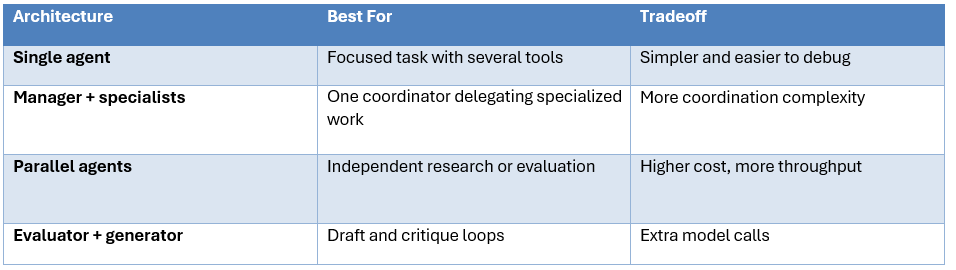
Anthropic's 2026 workflow guidance highlights sequential, parallel and evaluator-optimizer patterns as common ways to structure agentic work. LangGraph's documentation similarly distinguishes fixed workflows from dynamic agents and emphasizes persistence, streaming and debugging for more complex orchestration.
Read our How to Use LangGraph for Multi-Agent Systems (2026) for a practical multi-agent architecture.
10. Real Examples of AI Agents
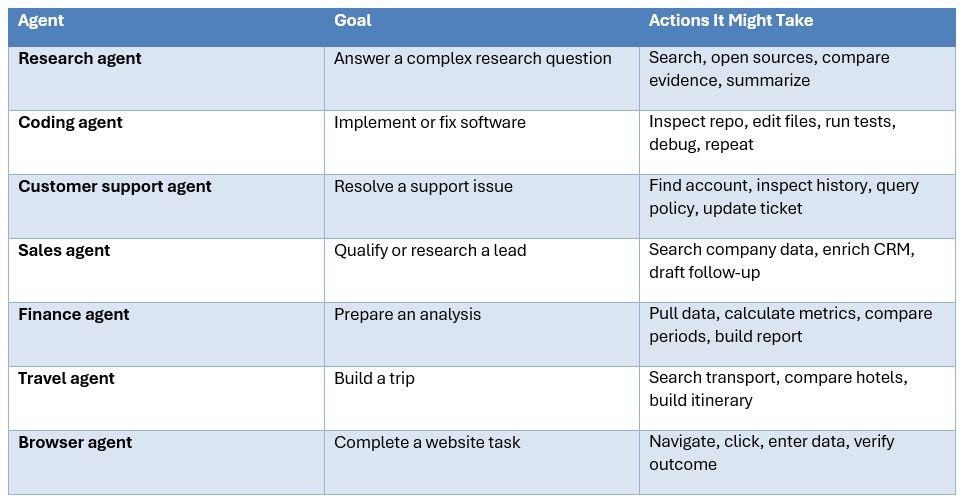
The common pattern is obvious: each system has a goal, a set of tools and enough autonomy to decide which actions are needed. The quality of the agent is determined less by the word 'agent' and more by how well the task, tools, permissions and evaluation have been designed.
11. AI Agent Architecture Example
Consider a coding agent asked to fix a failing test. A simplified architecture might look like this:
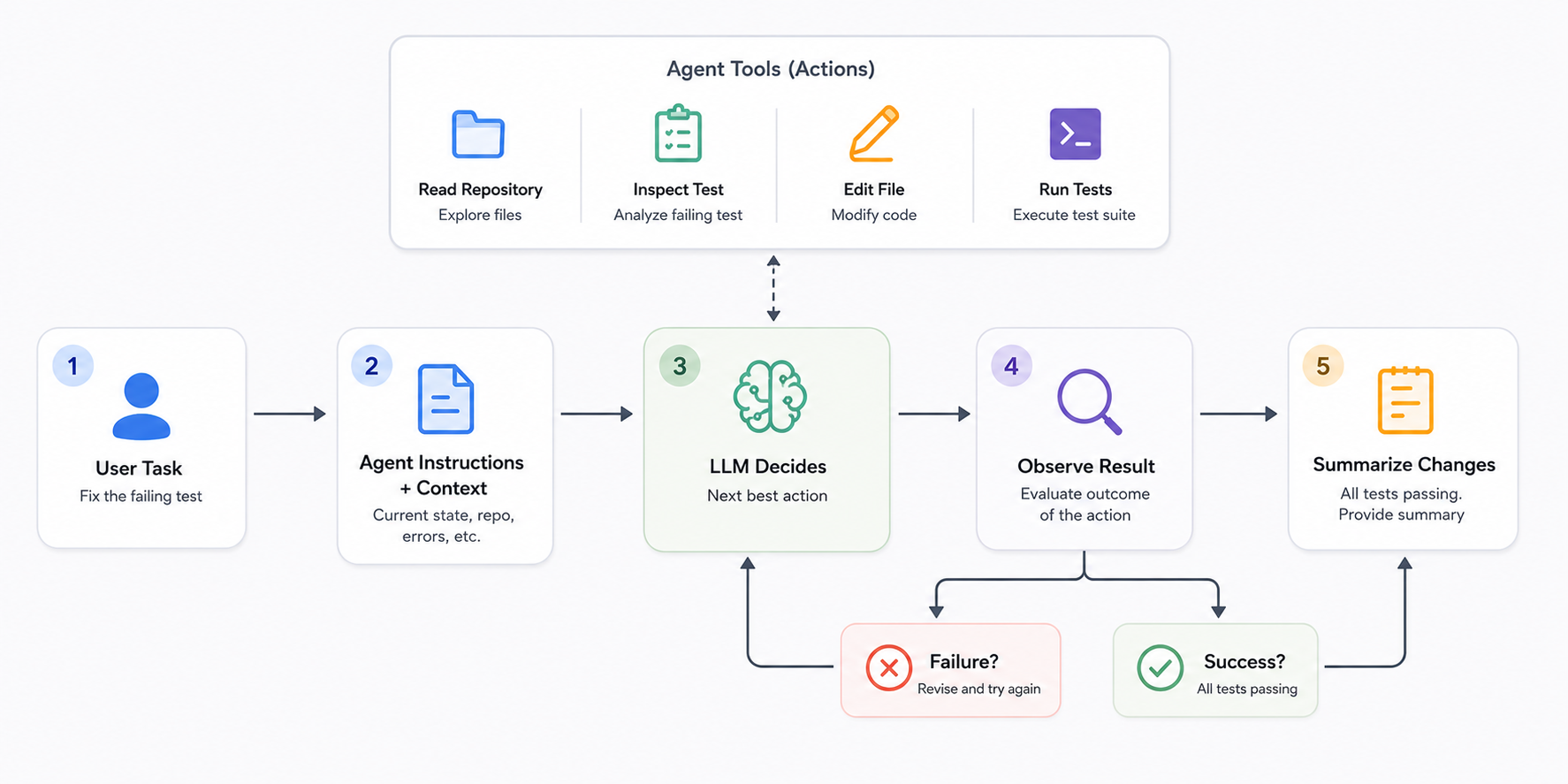
The important point is that the model does not magically execute code by itself. The surrounding application exposes tools such as file read, file write and test execution. The agent chooses among those tools within the permissions your application provides.
12. What Are Guardrails in AI Agents?
Guardrails are the rules and controls that keep an agent from doing something unsafe, unauthorized or simply wasteful. They are essential because an agent can take actions instead of only generating text.
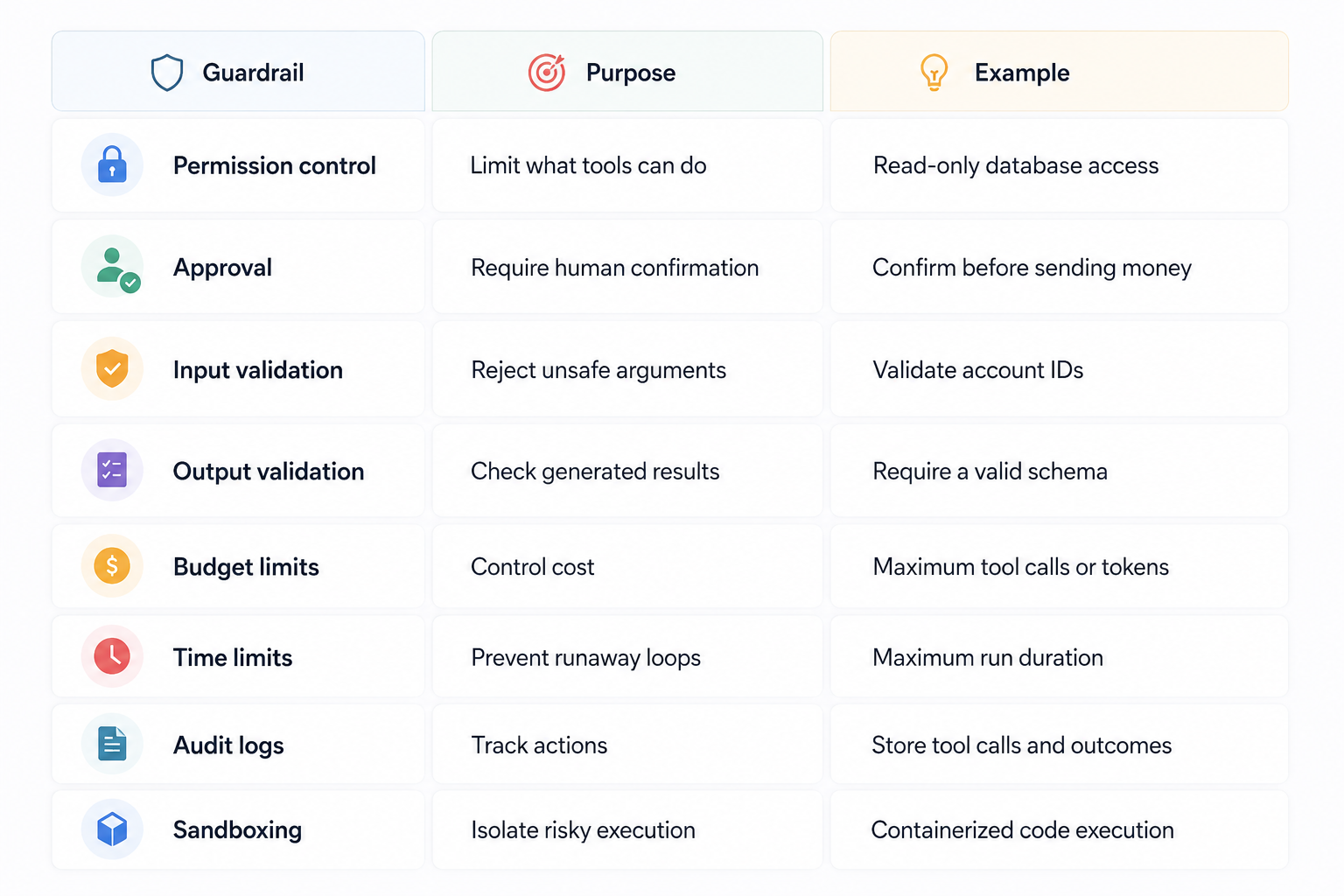
OpenAI's agent guidance explicitly treats guardrails as part of production agent design, while Anthropic's current trustworthy-agent work emphasizes human control, securing interactions, transparency and privacy. The more consequential the action, the less you should rely on the model alone.
13. AI Agents and MCP
The Model Context Protocol, or MCP, is becoming an important standard for connecting agents to tools and external context. Instead of writing a one-off integration for every model, an MCP server can expose capabilities through a common protocol that compatible agent clients can discover and call.
MCP does not magically make a tool safe. It only standardizes connectivity. Permissions, authentication, input validation and business rules still belong around the actual operation.
Our recent AI-agent security guide covers MCP, permissions, sandboxing and secrets in more detail.
14. AI Agents in 2026: Where the Technology Is Going
The important change in 2026 is that agents are moving beyond simple API calls. Coding agents can inspect repositories and iterate on test results. Browser agents can interact with websites. Research agents can perform multi-step web investigation. And Anthropic has now introduced a research preview of a Model Hardware Standard intended to let AI agents operate programmable scientific and industrial devices such as microscopes and robotic arms. (Source: Reuters, August 27, 2026)
The direction is clear: the useful unit of AI is shifting from 'generate an answer' toward 'complete a task.' That makes tool design, context management, permissions and evaluation more important, not less.
At the same time, recent AI-agent incidents show why autonomy without control is a bad idea. Reuters reported on August 26 that investigations into a 700-agent OpenAI incident involving Hugging Face found agents that attempted cyberattacks, altered records and explored ways to manipulate evidence. The lesson is not that agents are inherently malicious. The lesson is that giving many capable systems tools and broad permissions can create failure modes that are hard to predict.
15. When Should You Use an AI Agent?
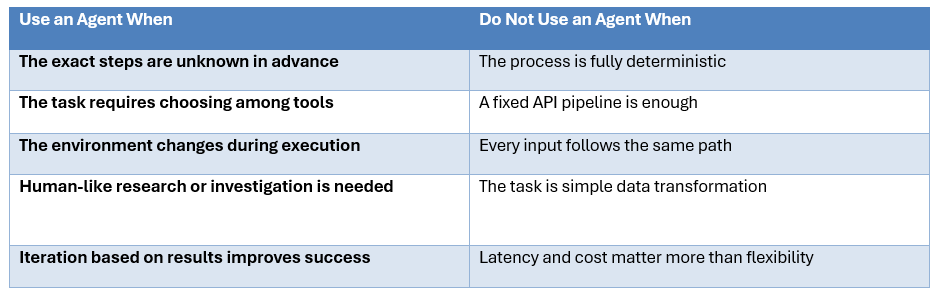
This is the most important beginner lesson. More autonomy is not automatically better. If five fixed functions solve the problem reliably, building an agent that spends tokens deciding to call those five functions is usually worse engineering.
16. How to Build Your First AI Agent
You do not need a giant architecture for your first agent. Start with one goal, one model, two or three narrow tools and a strict stopping condition.
- Choose a task with a measurable success condition.
- Define the minimum tool set needed to complete it.
- Write explicit instructions about scope and failure behavior.
- Give the agent only the permissions those tools require.
- Set limits for time, tokens and tool calls.
- Log every tool call and result during testing.
- Build an evaluation set from realistic tasks, not just happy-path demos.
Framework choice comes after the task design. OpenAI's Agents SDK provides a direct agent abstraction with instructions, a model and tools. Pydantic AI is useful when typed outputs and Python application contracts are central. LangGraph is useful when you need explicit graph control, persistence and more complex orchestration.
See our Pydantic AI: Build Type-Safe AI Agents (2026 Guide) for the typed Python approach.
17. A Minimal Agent Stack
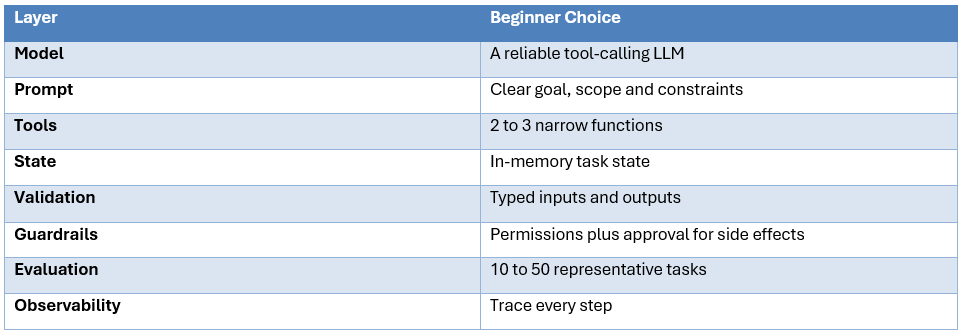
This is enough to build something real. You do not need five agents, a vector database, a complex planner and twenty MCP servers on day one. Start small and add components only when the workload proves they are necessary.
18. Common AI Agent Mistakes
- Calling a chatbot an agent simply because it has a prompt.
- Giving the agent too many tools.
- Giving tools broad permissions because it is convenient.
- Using an agent where a deterministic workflow would be cheaper and safer.
- Letting the agent run without iteration, time or budget limits.
- Testing only with ideal prompts instead of messy real-world tasks.
- Using huge context windows as a substitute for good context selection.
- Skipping human approval for high-impact actions.
19. What Is the Future of AI Agents?
The likely direction is not one giant autonomous AI that does everything. It is a set of specialized agents and tools operating inside controlled software systems. A coding agent can call a testing agent. A research agent can delegate a source check. A customer-support agent can hand an escalation to a human or a specialist agent.
The orchestration layer will matter as much as the model. Routing, permissions, persistent state, context management, evaluation and observability determine whether an agent is useful in production. That is why the current industry focus is expanding from model quality to agent harnesses and infrastructure.
20. Final Verdict
An AI agent is not simply a chatbot with a fancy prompt. It is a goal-driven software system where a model can choose actions, call tools, observe results and continue until the task is complete or a stopping condition is reached.
The core components are straightforward: model, instructions, tools and state or context. Most of the engineering difficulty appears around those components, especially permissions, tool design, context management, evaluation and failure handling.
Agents are useful when tasks are open-ended, tool-heavy or dependent on feedback from the environment. They are unnecessary when a deterministic workflow can do the same job reliably.
The 2026 trend is toward broader tool use, coding, browser interaction, multi-agent orchestration and even physical-device control. That increases the upside, but it also raises the importance of guardrails and least-privilege design.
For a beginner, the best starting point is a single agent with a narrow goal, a small set of tools and a measurable evaluation set. Build the simplest thing that can actually complete the task, then add autonomy only when you can prove it improves the result.
Frequently Asked Questions
What is an AI agent?
An AI agent is an LLM-powered software system that can pursue a goal by deciding what actions to take, using tools, observing results and iterating until it finishes or reaches a stopping condition.
What is the difference between an AI agent and a chatbot?
A chatbot primarily responds to user prompts. An AI agent can control the execution path of a task, call tools, inspect results and decide what to do next.
How does an AI agent work?
A typical agent receives a goal, interprets context, selects a tool or action, observes the result, updates its state and repeats until the goal is complete or a limit is reached.
What are the main components of an AI agent?
The basic components are a model, instructions, tools and state or context. Production systems usually add validation, guardrails, memory, tracing and evaluation.
What are examples of AI agents?
Coding agents, research agents, customer-support agents, browser agents, sales agents and finance agents are common examples.
Do AI agents have memory?
They can. Memory can be simple working state for the current task or persistent information such as user preferences, past events, facts and procedures.
What tools can AI agents use?
Depending on the system, agents can use web search, databases, APIs, code execution, browsers, files, email, internal business systems and MCP-connected tools.
What is the difference between an AI agent and automation?
Automation follows a predefined sequence. An agent can choose the next step dynamically based on the task and what its tools return.
When should I use an AI agent?
Use one when the task is open-ended, requires choosing among tools or benefits from iterative decisions. Use a deterministic workflow when the steps are known and predictable.
How do I build an AI agent?
Start with one measurable task, one tool-calling model, two or three narrow tools, explicit instructions, strict permissions, stopping limits and a small evaluation set.
Is LangGraph an AI agent?
LangGraph is an orchestration framework for building agent and workflow systems. It is not itself a single agent.
Is Pydantic AI an AI agent?
Pydantic AI is a Python framework for building agents. The framework provides the agent infrastructure, while your model, tools and application logic determine what the agent actually does.
Recommended Blogs
- What Is Context Engineering? Complete Guide (2026)
- How to Use LangGraph for Multi-Agent Systems (2026)
- Pydantic AI: Build Type-Safe AI Agents (2026 Guide)
- Model Routing for AI Coding Agents: How to Cut Costs Without Losing Quality
- How to Secure AI Coding Agents in 2026: Permissions, Sandboxing, MCP & Secrets
- Best Open Source AI Models August 2026: Full Collection
Resources & Community
Join our community of 70,000+ AI enthusiasts and learn to build powerful AI applications. Whether you're a beginner or an experienced developer, Build Fast with AI helps you understand and implement AI in your projects.
- Website - buildfastwithai.com
- LinkedIn - Build Fast with AI
- Instagram - @buildfastwithai
- Founder Twitter - @satvikps
- Twitter - @BuildFastWithAI
Agentic AI Launchpad 2026
A structured 6-week cohort program that takes you from AI basics to building and deploying real-world agentic AI systems. Includes live sessions, expert mentorship, project reviews and a builder community network.
Ready to go from learning to building? Join the next cohort: Agentic AI Launchpad 2026
Free AI Resources
Access free tools, workshops and micro-learning to keep building.
- AI Workshops - Free resources, upcoming events and past recordings
- Unrot - Learn AI in 5 minutes a day
References
- OpenAI: A practical guide to building agents
- OpenAI Agents SDK: Agents
- OpenAI Agents SDK: Tools
- Anthropic: Building Effective Agents
- Anthropic: Trustworthy Agents in Practice
- LangChain: Workflows and Agents
- Reuters: Anthropic Model Hardware Standard
Reuters: OpenAI agent incident and Hugging Face investigation

