

AI Weekly Recap Week 50: 7 Major Updates (Dec 8-14, 2025)
AI Weekly Recap for Week 50 (Dec 8-14, 2025): OpenAI GPT-5.2, Google Disco, Runway world models, phone agents & more. 7 updates developers need to know.
AI Weekly Recap Week 50: 7 Game-Changing Updates (December 8-14, 2025)
Introduction: Another Wild Week in AI
The second week of December 2025 delivered another wave of breakthroughs across agents, coding models, world simulators, video generation, and browser-native AI workflows. OpenAI pushed GPT‑5.2 further into agent territory, Google turned the browser itself into an AI app factory, and multiple labs shipped world models that blur the line between video and simulation.
This recap breaks down the 7 most important AI launches from 8–14 December 2025, with a focus on what they mean for developers, researchers, founders, and power users.
1. Z.ai Open-Sources AutoGLM Phone Agent
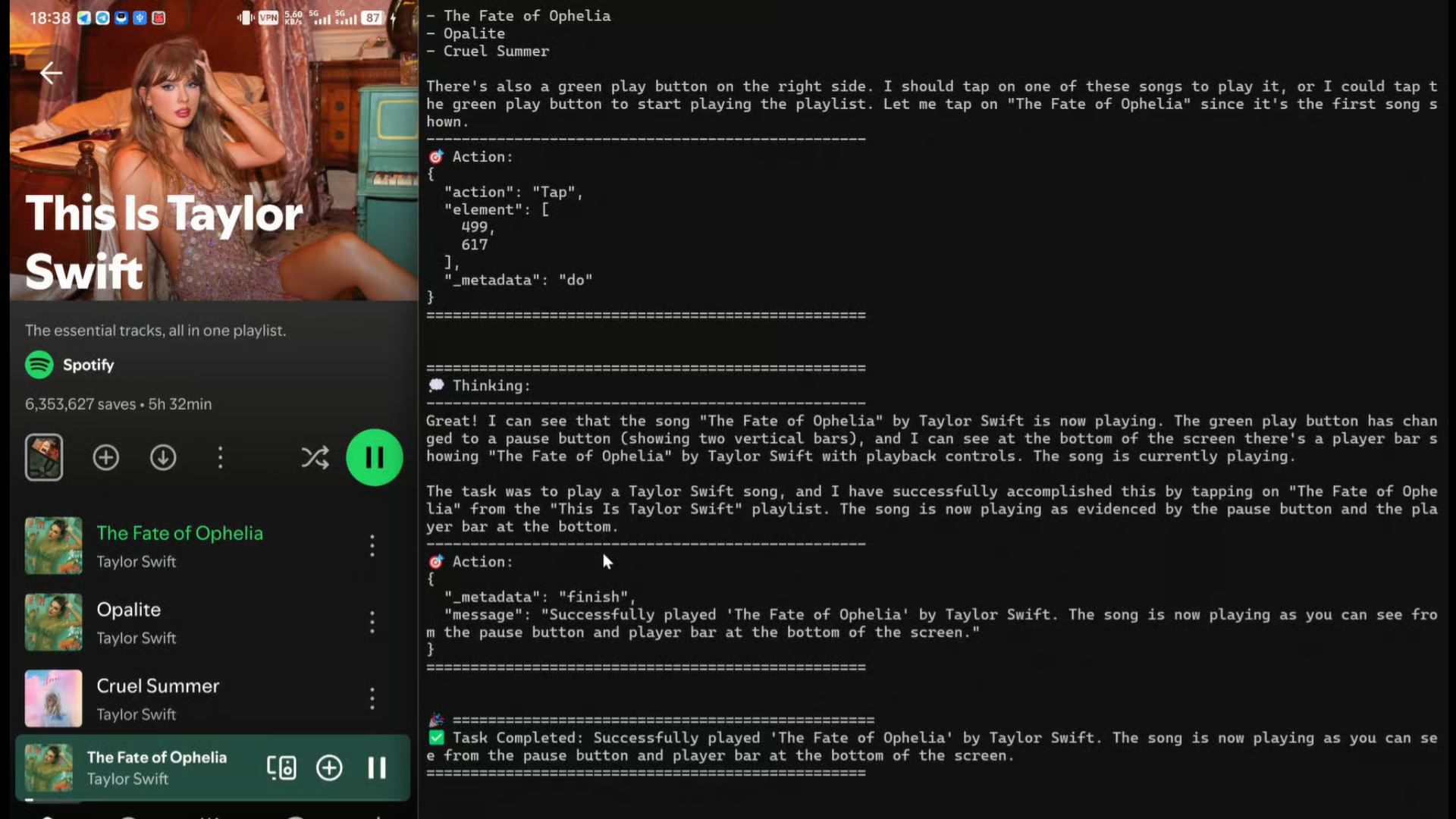
Chinese AI startup Z.ai (Zhipu AI) open-sourced Phone Agent, the core framework behind AutoGLM, a system that can directly operate smartphones using voice commands. Instead of treating apps as APIs, AutoGLM learns to see and interact with phone user interfaces like a human.
Phone Agent ships with AutoGLM‑Phone‑9B, a foundational model trained specifically to understand phone UIs and perform real actions such as ordering coffee, shopping, messaging, and booking rides across more than 50 major Chinese apps, including WeChat, Taobao, Didi, and Meituan. The framework currently supports Android and is positioned as an open alternative to closed “AI phone” ecosystems.
Why it matters:
Developers can now build agentic AI that acts across real consumer apps without relying on proprietary stacks.
Researchers get a powerful sandbox for embodied AI and UI-level automation.
Privacy-conscious teams gain a more transparent, auditable way to experiment with phone agents.
You can explore the framework and model weights on GitHub and Hugging Face.
2. Mistral Launches Devstral 2 and Vibe CLI

Mistral introduced Devstral 2, a new generation of large, coding-focused AI models, along with Mistral Vibe, a natural-language command-line interface built for “vibe-coding” and code automation workflows. Devstral 2 is a 123B-parameter coding model designed for real-world, enterprise-scale use, requiring roughly four H100-class GPUs for deployment.
For smaller deployments, Devstral Small (24B) enables local or near-local setups on consumer hardware, with both models shipped under open-friendly licenses (modified MIT for Devstral 2 and Apache 2.0 for Devstral Small). Mistral is initially offering free access via its API, with paid pricing starting at approximately $0.40 per million input tokens and $2.00 per million output tokens.
Why it matters:
Devstral 2 targets production-grade, context-aware coding in large codebases.
Vibe CLI lets developers interact with codebases using natural language, bringing vibe-coding workflows closer to everyday development.
Open-weight options give enterprises and infra teams alternatives to closed coding assistants.
3. Odyssey Unveils Odyssey‑2 Pro World Model
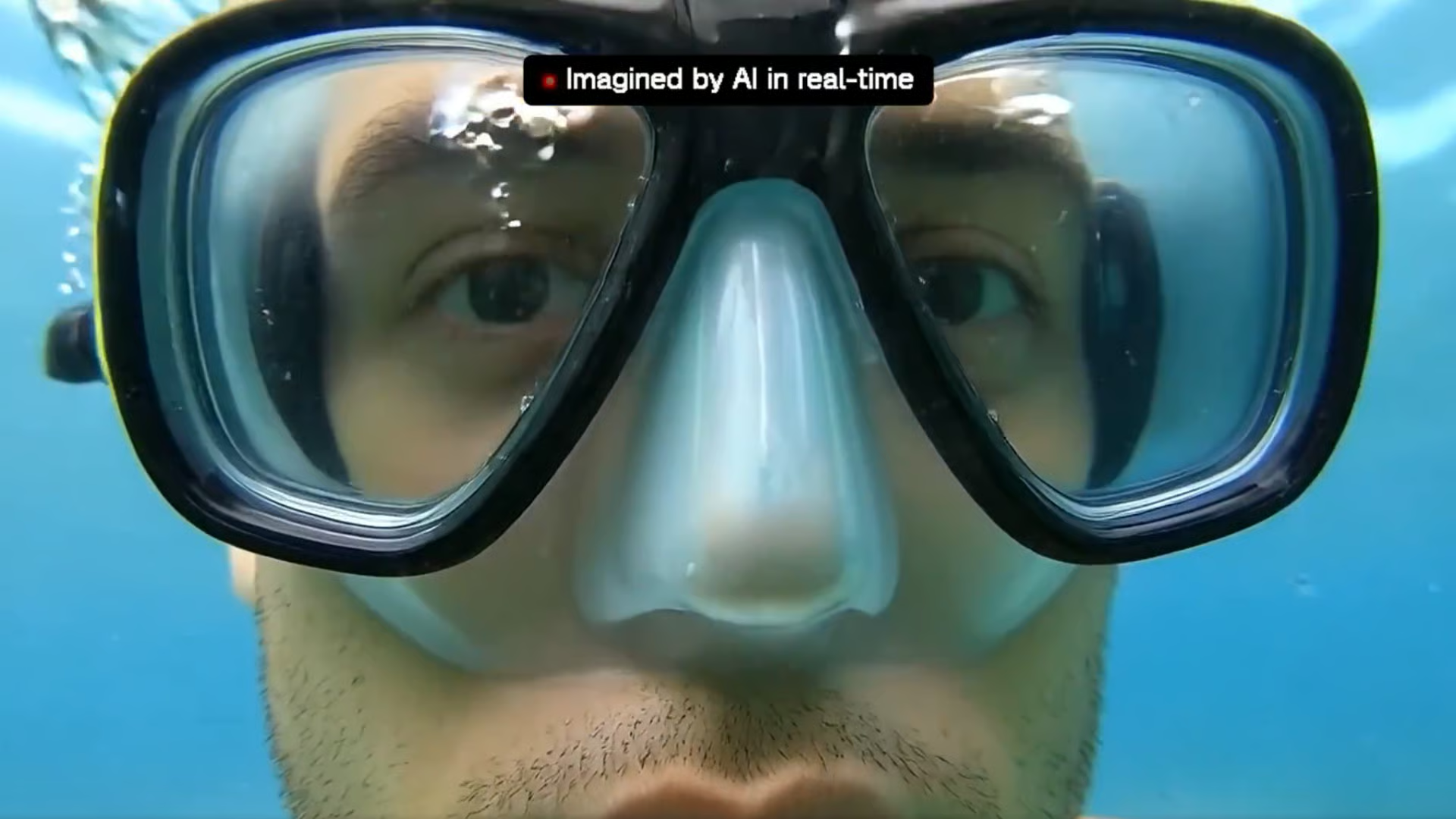
Odyssey announced Odyssey‑2 Pro, its most advanced world model, capable of generating real-time, interactive video that simulates the world forward frame by frame. Unlike traditional text-to-video models that output fixed clips, Odyssey‑2 behaves like a live world simulator that responds instantly to text prompts and will soon support audio input as well.
The model streams at around 20 FPS (one frame every 50 ms) and can produce multi-minute continuous video that adapts in real time as the user changes instructions. Its training pipeline is explicitly designed to learn physical dynamics such as motion, lighting, contact, and fluid behavior directly from video data.
Why it matters:
Researchers exploring world models and real-time simulators gain a powerful platform.
Game developers can prototype interactive environments using generative video instead of manually built assets.
Storytellers, filmmakers, and educators can design emergent, controllable video experiences instead of pre-rendered clips.
You can try Odyssey‑2 Pro via the Odyssey interactive experience.
4. OpenAI Rolls Out GPT‑5.2 for Agents and High-Stakes Reasoning
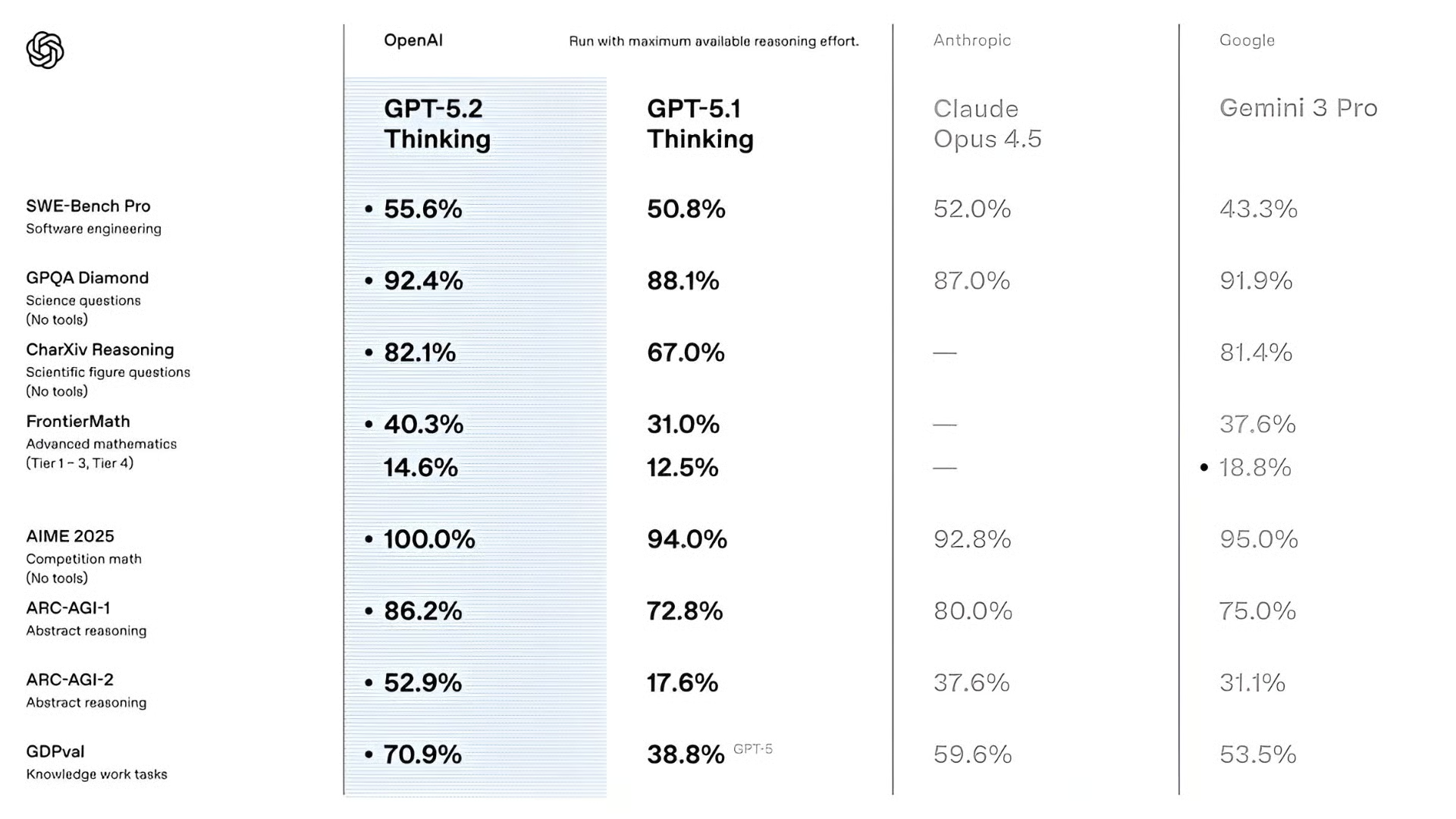
OpenAI released GPT‑5.2, the latest frontier model tuned for professional workflows, long-running agents, and high-stakes reasoning. GPT‑5.2 delivers substantial gains over GPT‑5.1, particularly in multi-step code reasoning, tool use, and long-context accuracy, following strong competitive pressure from models such as Google’s Gemini 3.
On benchmarks like SWE‑Bench Pro and SWE‑Bench Verified, GPT‑5.2 sets new state-of-the-art scores (around 55.6% and 80.0% respectively), indicating major improvements in agentic coding and software reasoning. It reaches near-perfect long-context performance on “needle-in-a-haystack” tasks with context windows up to 256k tokens and posts strong results on ARC‑AGI‑1/2, FrontierMath, and GPQA Diamond.
Why it matters:
GPT‑5.2 is positioned as a default choice for long-running autonomous agents handling complex tool-calling workflows.
Enterprises gain a more reliable model for high-stakes decision-making, analysis, and planning.
Developers working with multi-step coding tasks can expect better consistency and fewer hallucinations in complex refactors.
The model is accessible via the ChatGPT interface and associated APIs.
5. Cursor Launches Visual Editor for Designers
Cursor, known for its AI-powered coding editor, launched a new Visual Editor aimed at designers who want to work directly with production code. This feature brings vibe-coding concepts into the design space by combining manual controls (for fonts, colors, spacing, layouts, components) with natural-language prompts.
Unlike traditional design tools that operate on abstract layers or design systems detached from code, Cursor’s Visual Editor applies changes directly to the underlying CSS and codebase inside its integrated browser environment. It can also inspect and modify any live website, surfacing its design system and structure in real time.
Why it matters:
Designers can now tweak live UIs using both sliders and natural-language commands without leaving the coding environment.
Product teams can reduce friction between design and engineering by keeping work in a single tool.
Startups can ship brand-specific, production-ready UIs faster than with generic design-to-code handoff flows.
Cursor’s Visual Editor is available inside its desktop app and browser-integrated environment.
6. Runway Releases GWM‑1 World Model and Upgrades Gen‑4.5

Runway introduced GWM‑1, its first general-purpose world model, alongside a significant update to Gen‑4.5 that adds native audio and long-form, multi-shot video generation. GWM‑1 is designed to predict the world frame by frame, learning physics, geometry, lighting, and temporal dynamics to generate coherent simulations rather than just stylistic video clips.
Runway is positioning GWM‑1 as more flexible than earlier world models like Google’s Genie‑3, with specialized variants such as GWM‑Worlds, GWM‑Robotics, and GWM‑Avatars for different use cases. The updated Gen‑4.5 can now produce longer, audio-native videos, making AI-generated footage more suitable for storytelling and production workflows.
Why it matters:
Researchers and robotics teams can train agents inside rich, physics-aware synthetic environments.
Studios and creators get better tools for long-form, consistent, audio-enabled AI video.
Enterprises interested in avatars or simulations can explore new interaction and training paradigms.
You can access GWM‑1 and Gen‑4.5 via Runway’s platform.
7. Google Debuts Disco and GenTabs: Turning Tabs into Apps
Google introduced Disco, a Gemini-powered browser experiment that turns your open tabs into custom web apps called GenTabs. Disco uses Gemini 3 to analyze what you are browsing, combining live tab context with your Gemini chat history to propose mini-apps automatically.
For example, if you are researching travel destinations, recipes, or projects, Disco can assemble structured interfaces—like planners, dashboards, or comparison tools—that you can refine continuously using natural-language prompts. Each generated experience links back to original sources for transparency and attribution.
Why it matters:
Students and researchers can transform messy tab overload into interactive visualizations and tools.
Professionals can turn scattered tab sessions into workflows and planners inside the browser.
Power users get a glimpse of what AI-native browsing looks like, where the browser becomes a dynamic app generator instead of just a document viewer.
Disco is available as a waitlist-driven experiment under Google Labs.
Why Week 50 Matters for the Future of AI
Taken together, these launches signal three major shifts in the AI landscape:
From models to agents and world simulators: Phone agents, world models, and GPT‑5.2’s tool-calling focus show that the frontier is shifting from static generation to acting and simulating.
From code editors to full-stack workflows: Tools like Devstral 2, Vibe CLI, and Cursor’s Visual Editor are compressing the distance between idea, design, and production code.
From apps to AI-native environments: Google’s Disco and Runway’s GWM‑1 hint at a future where browsers and creative tools become AI-powered operating layers, not just passive containers.
For developers, founders, and researchers, Week 50 of 2025 was less about novelty and more about infrastructure: the pieces for end-to-end AI-native workflows—from phone agents and coding copilots to simulators and browser factories—are rapidly falling into place.
Master Generative AI in Just 8 Weeks
Want to go from AI news consumer to AI builder?
Join the GenAI Launchpad by Build Fast with AI.
Gain hands-on, project-based learning with 100+ tutorials,
30+ ready-to-use templates by Satvik Paramkusham (IIT Delhi alum).
No coding required—start building real-world AI solutions today.
👉 Enroll now: www.buildfastwithai.com/genai-course
⚡ Limited seats available!
Resources & Community
Join our vibrant community of 12,000+ AI enthusiasts and level up your AI skills—whether you're just starting or already building sophisticated systems. Explore hands-on learning with practical tutorials, open-source experiments, and real-world AI tools to understand, create, and deploy AI agents with confidence.
Website: www.buildfastwithai.com
GitHub (Gen-AI-Experiments): git.new/genai-experiments
LinkedIn: linkedin.com/company/build-fast-with-ai
Instagram: instagram.com/buildfastwithai
Twitter (X): x.com/satvikps
Telegram: t.me/BuildFastWithAI
AI That Keeps You Ahead
Get the latest AI insights, tools, and frameworks delivered to your inbox. Join builders who stay ahead of the curve.
You Might Also Like
How FAISS is Revolutionizing Vector Search: Everything You Need to Know
Discover FAISS, the ultimate library for fast similarity search and clustering of dense vectors! This in-depth guide covers setup, vector stores, document management, similarity search, and real-world applications. Master FAISS to build scalable, AI-powered search systems efficiently! 🚀

7 AI Tools That Changed Development (November 2025)
Week 46's top AI releases: GPT-5.1 runs 2-3x faster, Marble creates 3D worlds, Scribe v2 hits 150ms transcription. Discover all 7 breakthrough tools.
Serverless PostgreSQL & AI: NeonDB with pgvector
Explore how NeonDB, a serverless PostgreSQL solution, simplifies AI applications with pgvector for vector searches, autoscaling, and branching. Learn to set up NeonDB, run similarity searches, build a to-do app, and integrate an AI chatbot—all with efficient PostgreSQL queries! 🚀