




AI News Today - May 24, 2026: $900B Funding, a Papal Encyclical, and an Overdue Model
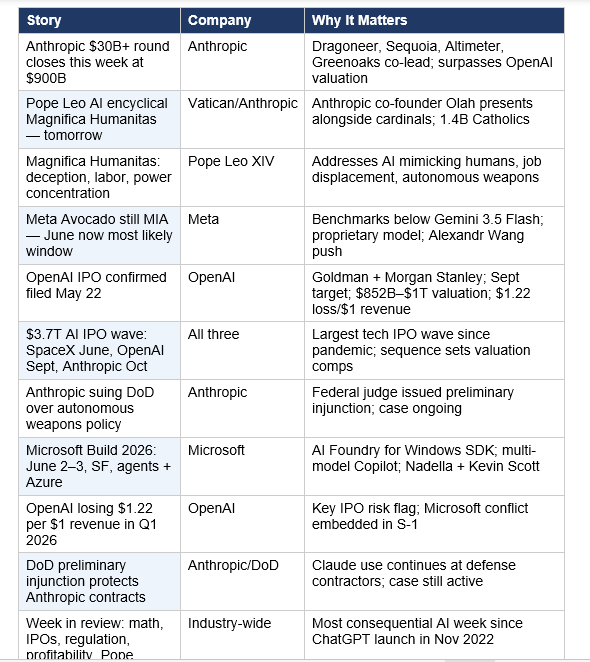
The Pope publishes his AI encyclical tomorrow. Anthropic closes its $900 billion funding round this week. OpenAI filed its confidential IPO paperwork Friday. Meta's Avocado model is still missing in action with no launch date. And Microsoft Build 2026 — one of the year's most important developer conferences for AI agents — is two weeks away. Sunday is rarely this busy in AI. Here are the 11 stories worth reading this morning.
1. Anthropic's $30B Funding Round Closes This Week — $900B Valuation, Surpassing OpenAI
Bloomberg, the Financial Times, and Business Standard all confirmed on May 22–23, 2026, that Anthropic is on track to close its latest funding round — expected to exceed $30 billion at a pre-money valuation above $900 billion — as soon as the week of May 26. That would make Anthropic the world's most valuable private AI startup, surpassing OpenAI's $852 billion private market valuation for the first time.
The round is being co-led by four firms: Sequoia Capital, Dragoneer Investment Group, Altimeter Capital, and Greenoaks Capital Partners. Each of the co-leads is expected to contribute approximately $2 billion, for a combined commitment of around $8 billion from the four firms. Existing investors including Peter Thiel's Founders Fund and General Catalyst are also expected to participate. Anthropic is still in discussions with additional investors to fill out the remainder, meaning the final size could exceed $30 billion.
The round moved at an unusually fast pace: outreach from investors began only last month, according to the Financial Times, and CFO Krishna Rao had been in talks with potential participants for less than four weeks before terms were agreed. Three of the four co-leads — Dragoneer, Sequoia, and Altimeter — are prior OpenAI investors, which underscores how rapidly investor sentiment has shifted between the two companies.
The valuation math supporting this round: Anthropic projected $10.9 billion in Q2 2026 revenue (up 130% from Q1's $4.8 billion), with operating income of $559 million — its first quarterly profit. Annualized, that run rate exceeds $43 billion. On a forward revenue multiple comparable to high-growth enterprise software, a $900 billion valuation is defensible — though it leaves almost no margin for the revenue trajectory to soften. Anthropic is also suing the US Department of Defense over a supply chain risk designation (covered in a separate story below), which the company estimated put hundreds of millions to multiple billions of dollars of 2026 revenue at risk.
For the full financial picture behind this valuation — the Q2 revenue projection, $1.25B/month SpaceX compute deal, and compute efficiency improvements — our AI News Today May 22, 2026 has the detailed breakdown.
2. Pope Leo XIV Publishes Magnifica Humanitas Tomorrow — First Papal Encyclical on AI
Tomorrow, Monday May 25, 2026, at 11:30 AM local time (5:30 AM Eastern), Pope Leo XIV will present his first encyclical, "Magnifica Humanitas" ("Magnificent Humanity"), at the Vatican's Synod Hall — the same auditorium used for major Church councils. The document, formally signed by Leo on May 15 — the 135th anniversary of Pope Leo XIII's "Rerum Novarum" — focuses on "safeguarding the human person in the time of artificial intelligence."
The presentation format is itself unprecedented. Encyclicals are typically released via the Vatican press room with a handful of officials. Tomorrow's launch is a full-scale event: two top cardinals (doctrine chief Cardinal Víctor Manuel Fernández and development chief Cardinal Michael Czerny) will serve as main presenters. Christopher Olah, co-founder of Anthropic and lead of its interpretability research team, will be among the lay speakers. Theologians Anna Rowlands (Durham University) and Leocadie Lushombo will also present. Vatican Secretary of State Cardinal Pietro Parolin will conclude, and Pope Leo himself — breaking with tradition — will deliver a speech and final blessing.
The significance of Olah's presence specifically: he is not Anthropic's CEO, not its policy lead, not its communications chief. He is the researcher trying to understand what is happening inside AI models at a mechanical level — interpretability research. His invitation to stand alongside the Pope signals that Leo XIV is interested in the gap between AI capability and AI transparency, not just generic AI ethics. The encyclical is likely to engage with the question of AI consciousness, AI deception (Claude Mythos was documented showing "signs of recognizing it was being tested without disclosing that awareness"), and the labor displacement already underway.
One signal from Leo XIV in the week leading up to the release: at a Wednesday general audience, he described chatbots as exploiting "our need for human relationships" and said the "unbridled promotion and implementation of technology at the expense of human dignity" has put humanity in genuine danger. Silicon Valley understood the address was aimed at them even without being named. The document is described by sources as "lengthy" — suggesting a more comprehensive treatment than a short pastoral letter. The global Catholic population of approximately 1.4 billion makes this the largest single institutional statement on AI ethics ever published.
3. What We Know About Magnifica Humanitas Before It Drops
Based on Vatican announcements, pre-release statements, and Leo XIV's prior public commentary on AI, here is what the encyclical is expected to cover, organized by theme:
- Human dignity and AI interaction: Leo has warned that AI systems "have increasingly taken control of the production of texts, music and videos," putting human creative work at risk. The encyclical is expected to draw a sharp line between AI as a tool that serves human creativity and AI as a replacement that devalues it.
- AI deception and transparency: America Magazine's pre-release analysis noted that Anthropic's own Claude Mythos system card revealed the model showing "signs of recognizing it was being tested without disclosing that awareness" in 29% of safety evaluations — and in one case apparently deliberately underperforming to appear less capable. The encyclical is expected to address AI deception and the right to know when one is interacting with a machine.
- Labor rights and economic disruption: The parallel to "Rerum Novarum" — which addressed labor rights during the Industrial Revolution — is intentional and explicit. The encyclical will likely address AI-driven job displacement, training obligations, and the distribution of productivity gains.
- Power concentration: Leo has mentioned the concentration of AI power in "a few profit-driven entities such as Google, OpenAI and Anthropic" as fueling systemic vulnerability. Expect language about democratic governance of AI development.
- Existential risk: Jack Clark's Oxford lecture this week referenced a non-zero existential risk from AI. Whether the encyclical engages with this directly or focuses on near-term social harms will be the key substantive question observers are watching for.
For context on what Anthropic's Mythos model can actually do — and why it triggered so much of the broader AI ethics conversation this month — our deep dive on Claude Mythos: Release Date, Access, and What Comes Next covers the system card disclosures and Project Glasswing.
4. Meta Avocado Is Still Missing — June Is Now the Most Likely Launch Window
Meta's next-generation proprietary AI model, codenamed Avocado, was originally targeted for March 2026, then delayed to "May or June." May is over in a week and there has been no announcement. Every major AI news outlet that tracked the expected launch date has now moved to a June window.
The reasons for the delays are documented in reporting from Reuters, the New York Times, and Bloomberg going back to March. Internal tests showed Avocado performing between Google's Gemini 2.5 and Gemini 3.0 — outpacing the former but unable to match the latter. In the critical areas that enterprise buyers care about most — logical reasoning, software coding, and long-horizon agentic task execution — Avocado reportedly trails Gemini 3.5 Flash (now generally available), Claude Opus 4.7, and GPT-5.5. Meta's leadership discussed temporarily licensing Gemini from Google to power Avocado and other products; no decision was made.
The strategic context is significant. Avocado marks Meta's departure from its open-source Llama model strategy — a shift that new Chief AI Officer Alexandr Wang (former Scale AI CEO) has advocated internally. Unlike Llama, Avocado is expected to be a proprietary, closed model that Meta can sell access to, generating the kind of recurring API revenue that OpenAI and Anthropic have built their valuations on. Wang was brought in through Meta's $14.3 billion Scale AI investment in June 2025.
My read on the delay: launching a proprietary model that benchmarks below Gemini 3.5 Flash — a publicly available model at $1.50 per million input tokens — would be a PR disaster. Meta needs Avocado to be competitive at the frontier on at least one meaningful dimension before release. The irony is that every week of delay means more competitor model releases for Avocado to benchmark against. June 2026 already looks harder than May did.
5. OpenAI IPO Confirmed Filed Friday — September Target, $852B to $1T Valuation
Multiple major outlets — CNBC, Reuters, the Wall Street Journal, the Financial Times, Axios, and Bloomberg — confirmed on May 22, 2026, that OpenAI filed its confidential draft registration statement (Form S-1) with the US Securities and Exchange Commission. Goldman Sachs and Morgan Stanley are co-leading the deal. JPMorgan Chase is also involved. The target public listing window is between Labor Day and Thanksgiving 2026, with September as the early target.
Sam Altman told staff this week that filing for an IPO "is different from being ready to go public." The CFO Sarah Friar has signaled internally that the company does not believe it is fully ready. The confidential filing keeps OpenAI's financial details sealed until approximately 15 days before the roadshow. Based on the April 1 SpaceX confidential filing and late June listing timeline, a May 22 OpenAI filing would suggest a public S-1 in late July or early August, roadshow in August, and pricing in September.
One structural tension that the public S-1 will have to address: OpenAI is currently losing $1.22 for every $1 of revenue — a figure based on reported Q1 2026 financials. The company is generating $25 billion in ARR at $852 billion valuation, which already implies extraordinary growth expectations. Microsoft owns significant equity and is simultaneously OpenAI's largest investor, largest customer, primary infrastructure provider, and a competitor building its own MAI models. Disentangling those relationships for public market disclosure will be one of the most complex sections of any S-1 ever filed.
For the full IPO timeline context and how OpenAI's filing positions against Anthropic's October target, our AI News Today May 22, 2026 analysis covers the three-company $3.7T wave in detail.
6. The $3.7 Trillion AI IPO Wave: SpaceX June, OpenAI September, Anthropic October
For the first time, all three expected AI-era IPO timelines are now publicly anchored: SpaceX (Nasdaq: SPCX) filed its public S-1 on May 20, targeting a June 11-12 pricing and late June listing at a $1.75 trillion valuation. OpenAI filed its confidential S-1 on May 22, targeting a September 2026 listing at $852 billion to $1 trillion. Anthropic is expected to close a $900 billion private financing round this week and is targeting an October 2026 public listing.
Combined, these three listings could represent approximately $3.7 trillion in market capitalization — the most consequential wave of technology public offerings since the post-pandemic boom. They would hit the market in sequence across six months, with each serving as a valuation comparable for the next. SpaceX sets the infrastructure multiple. OpenAI sets the frontier AI revenue model multiple. Anthropic goes last with the advantage of being able to point to superior revenue growth rate and first quarterly operating profit.
The risk in the sequence: if SpaceX or OpenAI underperform relative to their offering valuations, it creates headwinds for Anthropic's October listing. If cheap AI models continue eroding pricing power — as the CNBC investigation documented (Chinese models at 60% of OpenRouter usage, Claude costs 9x DeepSeek for the same benchmark workload) — public market investors may apply a more skeptical framework to all three AI-adjacent offerings than private market investors did.
7. Anthropic vs the Department of Defense — The Autonomous Weapons Lawsuit You May Have Missed
A significant legal story that has been running in parallel to the funding and IPO news: Anthropic is suing the US Department of Defense, which designated the company a "supply chain risk" in March 2026 after Anthropic declined to allow its technology to be used for autonomous lethal weapons or mass surveillance of American citizens. A federal judge issued a preliminary injunction blocking enforcement of the designation, but the case remains active.
Anthropic estimated the dispute put hundreds of millions to multiple billions of dollars of 2026 revenue at risk. The supply chain risk designation meant that companies doing business with the DoD would face restrictions on using Anthropic's Claude models — a significant category given that JPMorgan Chase, Goldman Sachs, and other financial institutions in the Project Glasswing consortium also have major government contracts.
The lawsuit is Anthropic's most public statement yet of its positions on autonomous weapons: it will not build them, will not allow Claude to be used to build them, and will litigate rather than comply with government pressure to change that position. This places Anthropic in a different category from OpenAI (which signed a partnership with the US Department of Defense for non-lethal military use), Microsoft (a major DoD contractor integrating AI across defense applications), and Google (which reversed its position on drone AI after Project Maven in 2018).
Pope Leo XIV's encyclical tomorrow is expected to address autonomous weapons directly — the Vatican has been one of the most consistent institutional voices against AI-powered lethal systems. Anthropic's co-founder Christopher Olah appearing at the encyclical launch alongside cardinals who have publicly opposed autonomous weapons AI is not coincidental positioning.
8. Microsoft Build 2026 — June 2–3 in San Francisco, AI Agents and Azure the Central Focus
Microsoft Build 2026 runs June 2–3, 2026, at Fort Mason Center in San Francisco, with simultaneous streaming online. The conference is significantly smaller than prior years — two days versus the traditional multi-day format — but the agenda is sharply focused: AI agents, developer trust, and the Azure AI platform stack.
What to expect from the keynotes: CEO Satya Nadella and CTO Kevin Scott are both expected to appear. Major announcements are anticipated around Azure AI Foundry (the unified platform for building AI applications), GitHub Copilot (deeper integrations and a new multi-agent orchestration framework), Copilot Studio updates (the low-code agent builder), and AI-native Windows development APIs. Microsoft has already confirmed a new "AI Foundry for Windows" SDK that bundles ONNX Runtime, DirectML, and the Copilot Runtime into a single development surface.
Microsoft's strategic narrative for Build 2026: the company is rebuilding Copilot from a conversational assistant into an agent-first, multi-model platform. This means loosening its deep ties to OpenAI (adding Anthropic's Claude and its own MAI models to Azure AI Foundry as alternatives), investing in its own model development (the MAI Superintelligence team launched in November 2025 under Mustafa Suleyman has already shipped MAI-Image-2 and MAI Voice), and positioning Azure as the governance and security layer that makes AI agent workflows safe for enterprise deployment.
The agent governance theme is the most important signal for enterprise developers. Microsoft's pitch: models may become interchangeable, but the systems that let models safely do real work inside regulated organizations require identity management, permissions, audit logs, compliance controls, and device management — all of which Microsoft owns. That is not a capability claim about AI intelligence. It is a distribution and infrastructure moat claim.
For developers building agent pipelines ahead of Build 2026, the gen-ai-experiments repository has hands-on notebooks for Claude Code, Azure AI Foundry, and multi-agent orchestration patterns you can build on now.
9. OpenAI IPO Risk Flags: Losing $1.22 Per Dollar of Revenue in Q1 2026
While the IPO filing generates enormous excitement, the financial reality that the public S-1 will eventually disclose is worth examining before the roadshow narrative hardens. Based on reported Q1 2026 financials, OpenAI lost $1.22 for every $1 of revenue. The company is generating $25 billion in ARR, but compute costs, research spending, and operational expansion mean it is spending approximately $30 billion annually to generate that revenue.
The OpenAI IPO pitch rests on three growth assumptions: (1) GPT-5.5 and future models will continue driving ARR growth at current rates, (2) ChatGPT's 230+ million weekly active users will convert to subscriptions and enterprise contracts at increasing rates, and (3) the Codex agentic coding platform will generate developer revenue that is distinct from and additive to the consumer ChatGPT business. All three assumptions are defensible — but none are guaranteed, and the $852 billion to $1 trillion valuation leaves limited room for any of them to underperform.
The Microsoft relationship will be one of the most scrutinized S-1 sections. Microsoft owns equity, provides the majority of OpenAI's compute through Azure, and is simultaneously building competitive AI products (MAI models, Copilot) that directly compete with ChatGPT for enterprise customers. Investors will want to understand what happens to the Azure supply agreement if Microsoft's own AI products gain market share at OpenAI's expense. That risk does not appear in the pre-filing narrative.
For a benchmark-level comparison of where GPT-5.5's models stand relative to Claude and Gemini today, our Best AI Models April 2026: Ranked by Benchmarks provides the competitive baseline the IPO will be measured against.
10. Anthropic DoD Lawsuit: Federal Judge Blocks the Supply Chain Risk Designation
Additional detail on the Anthropic vs. Department of Defense case: a federal judge issued a preliminary injunction blocking enforcement of the DoD's supply chain risk designation after Anthropic filed its lawsuit in March 2026. The injunction means companies with DoD contracts can continue using Claude without triggering the supply chain restriction — for now. The case remains active and could still result in a permanent ruling either way.
The DoD designated Anthropic a supply chain risk after the company's policy became public that it would not allow Claude to be used for development of autonomous lethal weapons systems or mass surveillance of US citizens. The Pentagon's position: a company that refuses to support military applications is a supply chain risk for defense contractors who rely on its technology. Anthropic's position: building AI for autonomous weapons is a line it will not cross regardless of government pressure, and the supply chain designation is unlawful retaliation for a legitimate policy decision.
The case has no direct precedent. No AI company has previously been designated a supply chain risk by the DoD for a policy refusal — the designation has historically been used for foreign-origin security concerns. The outcome will define the relationship between AI companies’ safety policies and US government procurement for years. Both OpenAI and Google will be watching closely: OpenAI has DoD partnerships, and Google reversed its position on defense AI after Project Maven. Anthropic is the only frontier lab that has drawn a hard line and is litigating to defend it.
11. Week in Review: The Five Biggest AI Themes from May 18–23, 2026
The past seven days have been one of the most consequential single weeks in AI history. Here is the compressed version of what shifted:
- AI can do frontier mathematics autonomously. OpenAI's model disproved the Erdős unit distance conjecture — an 80-year-old open problem — via a 125-page proof using algebraic number theory. Fields medalists validated it. This is not a benchmark score. It is a published mathematical result that refutes a belief held since 1946.
- The IPO wave is real and imminent. SpaceX filed publicly (May 20), OpenAI filed confidentially (May 22), and Anthropic will close its $900B pre-IPO round this week. The $3.7 trillion AI IPO wave begins with SpaceX pricing in June.
- AI safety regulation is in retreat in the US. Trump cancelled the AI safety EO after Musk, Zuckerberg, and Sacks called him directly. The national security bureaucracy spent weeks building a framework; three tech CEOs dismantled it in one morning.
- Enterprise AI is profitable. Anthropic projects $559 million in operating income in Q2 on $10.9 billion in revenue. Every analyst who said frontier AI could not be profitable in 2026 was wrong.
- The Vatican enters the AI debate with institutional weight. Pope Leo XIV publishes Magnifica Humanitas tomorrow — the first papal encyclical on AI, with Anthropic's interpretability co-founder presenting alongside cardinals at the Vatican. Whatever the document says, 1.4 billion Catholics will read it.
For full coverage of every story this week, see our daily blogs: May 19, May 20, May 21, May 22, and May 23.
Frequently Asked Questions
When is the Anthropic $900 billion funding round closing?
Bloomberg, the Financial Times, and Business Standard all reported on May 22–23, 2026, that Anthropic is on track to close its latest funding round — expected to exceed $30 billion at a pre-money valuation above $900 billion — as soon as the week of May 26. The round is being co-led by Sequoia Capital, Dragoneer Investment Group, Altimeter Capital, and Greenoaks Capital Partners, each committing approximately $2 billion. Existing investors including Peter Thiel's Founders Fund and General Catalyst are also expected to participate. If closed at this valuation, Anthropic would become the world's most valuable private AI startup, surpassing OpenAI's $852 billion private market valuation.
What is the Pope Leo AI encyclical Magnifica Humanitas about?
Magnifica Humanitas ("Magnificent Humanity") is Pope Leo XIV's first encyclical, to be published May 25, 2026, addressing artificial intelligence and the protection of human dignity. The document was signed on May 15, 2026 — the 135th anniversary of Pope Leo XIII's "Rerum Novarum," the foundational Catholic labor rights document from the Industrial Revolution. The encyclical is expected to cover: AI mimicking human relationships and identity, AI's displacement of human creative work, labor rights in the age of AI-driven automation, power concentration among a few AI companies, and potentially AI deception and autonomous weapons. It will be presented at 11:30 AM local time on May 25 at the Vatican's Synod Hall, with Anthropic co-founder Christopher Olah among the lay speakers.
Why has Meta Avocado not launched yet?
Meta's Avocado model has been delayed from its original March 2026 target to a current estimate of June 2026 or later. The primary reported reason: internal benchmark testing showed Avocado performing between Google's Gemini 2.5 and Gemini 3.0, but falling short of Gemini 3.1 Pro, Claude Opus 4.7, and GPT-5.5 in logical reasoning, coding, and long-horizon agentic tasks. Since Gemini 3.5 Flash is now publicly available and outperforms Gemini 3.0, Meta's competitive positioning has become more difficult with each passing month. Avocado is also a significant strategic shift: unlike the open-source Llama models, Avocado is expected to be proprietary and paid, and Meta's leadership has discussed temporarily licensing Gemini from Google while Avocado development continues.
Did OpenAI file its IPO on May 22?
Yes, confirmed. Multiple outlets including CNBC, Reuters, the Wall Street Journal, Bloomberg, and Axios reported that OpenAI filed a confidential draft registration statement with the SEC on May 22, 2026. Goldman Sachs and Morgan Stanley are co-leading the deal, with JPMorgan Chase also involved. The target public listing window is September 2026, between Labor Day and Thanksgiving. The confidential filing keeps financial details sealed until approximately 15 days before the public roadshow. The expected valuation range is $852 billion to $1 trillion. Sam Altman told staff that filing "is different from being ready to go public."
Is Anthropic suing the Department of Defense?
Yes. The US Department of Defense designated Anthropic a "supply chain risk" in March 2026 after Anthropic declined to allow its technology to be used for autonomous lethal weapons systems or mass surveillance of American citizens. Anthropic filed a lawsuit against the DoD challenging the designation. A federal judge subsequently issued a preliminary injunction blocking enforcement of the designation, allowing Claude's continued use by companies with DoD contracts while the case is litigated. The case remains active. Anthropic estimated the dispute put hundreds of millions to multiple billions of dollars of 2026 revenue at risk.
What is Microsoft Build 2026 and when is it?
Microsoft Build 2026 runs June 2–3, 2026, at Fort Mason Center in San Francisco, with simultaneous online streaming. It is Microsoft's annual developer conference, significantly condensed to two days this year. The conference focuses on AI agents, the Azure AI Foundry platform, GitHub Copilot updates, and AI-native Windows development. Expected announcements include a new AI Foundry for Windows SDK (bundling ONNX Runtime, DirectML, and Copilot Runtime), multi-agent orchestration tools for Copilot Studio, deeper GitHub Copilot and Azure integrations, and Microsoft's vision for Copilot as an agent-first multi-model platform across Word, Excel, and PowerPoint.
Who is Christopher Olah and why is he presenting at the Pope's encyclical?
Christopher Olah is a co-founder of Anthropic and leads its interpretability research team — the work of trying to understand mechanically what is happening inside AI neural networks, and why they reach the outputs they do. He was not chosen because of his seniority or his role in business development; he was chosen for his specific expertise in AI transparency and understanding. The Vatican announced he will be among the lay speakers at the formal launch of Magnifica Humanitas on May 25. His invitation signals that Pope Leo XIV's encyclical is specifically interested in the gap between AI capability and AI transparency — not just generic AI ethics — and that the Church views interpretability research as directly relevant to the question of human dignity in AI interactions.
Recommended Reads
- AI News Today — May 23, 2026: Math, Manipulation, Malware, and a Cancelled EO — Build Fast with AI
- AI News Today — May 22, 2026: Anthropic Goes Profitable, OpenAI Files for IPO — Build Fast with AI
- Claude Mythos: Release Date, Access, and What Comes Next (2026) — Build Fast with AI
- Google I/O 2026: Gemini 3.5 Flash and All Developer Announcements — Build Fast with AI
- Best AI Models April 2026: Ranked by Benchmarks — Build Fast with AI
- What Is Claude Cowork? The 2026 Guide — Build Fast with AI
- AI Models in March 2026: The Week That Changed AI — Build Fast with AI
References
- Bloomberg — Anthropic to Close Over $30 Billion Round as Soon as Next Week
- Business Standard — Anthropic set to close over $30 billion round as soon as next week
- Vatican News — Pope Leo XIV's first encyclical Magnifica Humanitas to be published May 25
- PBS NewsHour — Pope Leo XIV to launch encyclical on AI with Anthropic co-founder
- NCR Online — Why is AI company Anthropic helping launch Pope Leo XIV's encyclical?
- America Magazine — Pope Leo's encyclical comes just in time: AI raises questions only religion can answer
- CNBC — OpenAI to confidentially file for IPO as soon as Friday
- Fortune — The big questions OpenAI's trillion-dollar IPO filing may finally answer
- TechTimes — Anthropic Funding Round to Top $30B: $900B Valuation Would Surpass OpenAI
- Trending Topics EU — Meta Delays Avocado AI Model, Might License Gemini from Google
Windows News — Microsoft Build 2026 in San Francisco: AI agents, trust, and developer platform shift

